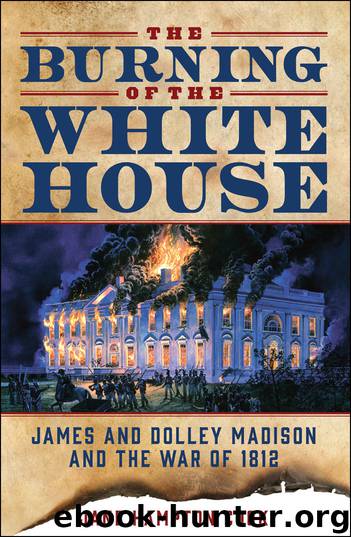
The Burning of the White House by Jane Hampton Cook
Author:Jane Hampton Cook
Language: eng
Format: epub
ISBN: 9781621575498
Publisher: Regnery Publishing
Published: 2016-07-28T04:00:00+00:00
Scott reached Cockburn’s and Ross’s “shepherd’s quarters” at two o’clock in the morning of August 24. He gave the message to Cockburn, who read it. Keeping his composure, Cockburn waited for Ross’s opinion. Soon blind obedience would combat justified rebellion.
Ross expressed diffidence, acknowledging the small force and their uncomfortable distance from their ships.
“Having perused it, he [Ross] remarked that there was now no other alternative than to return. ‘No,’ replied the admiral, ‘we cannot do that; we are too far advanced to think of a retreat: let us take a turn outside, and talk the matter over,’” Scott later recounted.
As Ross and Cockburn took a walk about camp, Scott heard some of the conversation, which he later recorded. “‘If we proceed,’ said our energetic commander, ‘I’ll pledge every thing that is dear to me as an officer that we shall succeed. If we return without striking a blow, it will be worse than a defeat—it will bring a stain upon our arms.’”
Cockburn did not let up easily. How could he? This is what he had been working toward for fifteen months.
“‘I know their force—the militia, however great their numbers, will not—cannot stand against your disciplined troops. It is too late,’ continued the admiral. ‘we ought not to have advanced—there is now no choice left us. We must go on.’”
Hearing this, General Ross struck his hand against his forehead and agreed. “Well, be it so, we will proceed.”
Because some of the soldiers and marines had heard they were to retreat, the men could not have been happier at the change. “A low murmuring burst of enthusiasm involuntarily escaped from the lips of the officers and men, sufficiently indicative of the spirit that animated the hearts of the gallant band. In less than five minutes the whole army were in full march for the capital of the United States.”
How did Cockburn justify their decision to his superior? As if pretending that he never received the communication, Cockburn coyly wrote Cochrane that he had joined Ross and conferred with him about further operations against the enemy, “and we were not long in agreeing on the propriety of making an immediate attempt on the city of Washington.”
Ross asked Cockburn to relocate his naval forces and join him. “In conformity therefore with the wishes of the general, I instantly sent orders for our marine and naval forces.”
Cockburn was thrilled. “I also most readily agreed to accompany.”
Finally, the British would launch an attack on the U.S. capital city, and Cockburn would help lead it. No matter that he was an admiral and that this was a land assault, he had what he wanted. Sure, he would defer to Ross, who had top authority while on land. But Cockburn secretly knew that he had Ross in the palm of his hand.
Leaving a company at Upper Marlborough, the rest broke camp “and bivouacked before dark about five miles nearer Washington.”
They were heading toward a town called Bladensburg, a village on the left bank of the Potomac’s Eastern Branch in Maryland.
Download
This site does not store any files on its server. We only index and link to content provided by other sites. Please contact the content providers to delete copyright contents if any and email us, we'll remove relevant links or contents immediately.
Fanny Burney by Claire Harman(26579)
Empire of the Sikhs by Patwant Singh(23057)
Out of India by Michael Foss(16837)
Leonardo da Vinci by Walter Isaacson(13282)
Small Great Things by Jodi Picoult(7098)
The Six Wives Of Henry VIII (WOMEN IN HISTORY) by Fraser Antonia(5482)
The Wind in My Hair by Masih Alinejad(5069)
A Higher Loyalty: Truth, Lies, and Leadership by James Comey(4937)
The Crown by Robert Lacey(4783)
The Lonely City by Olivia Laing(4782)
Millionaire: The Philanderer, Gambler, and Duelist Who Invented Modern Finance by Janet Gleeson(4441)
The Iron Duke by The Iron Duke(4333)
Papillon (English) by Henri Charrière(4235)
Sticky Fingers by Joe Hagan(4167)
Joan of Arc by Mary Gordon(4076)
Alive: The Story of the Andes Survivors by Piers Paul Read(4009)
Stalin by Stephen Kotkin(3936)
Aleister Crowley: The Biography by Tobias Churton(3620)
Ants Among Elephants by Sujatha Gidla(3449)
